SHORT STORIES

Beyond the Single Frame
Every photograph captures a single moment, but some moments
are part of a much larger journey. In these Short Stories, I invite you to step beyond the frame
and dive into the deeper narratives that unfold along my travels. From the vibrant streets of Asia to the quiet,
enduring traditions of remote villages—these photo essays document the lives, cultures, and hidden details of our world.
Join me on a visual journey where images and words come together to tell the full story.

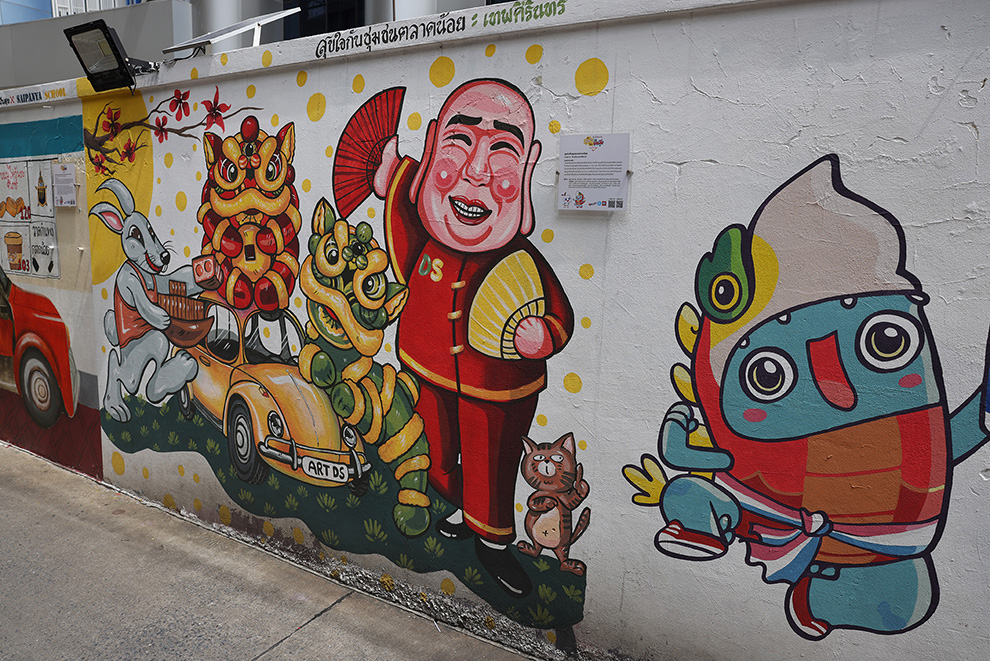
Bangkok Graffiti Wall

Bangkok Graffiti Wall - Thailand

Bangkok Graffiti Wall

A few decades ago, street art was frowned upon in Bangkok. In the early 2000s, graffiti was considered vandalism and was rejected by the majority of the population. But the underground scene continued to flourish, and a small, dedicated group of local artists tried to gain recognition for the art form.
A turning point came with the Bukruk Urban Arts Festival. Inspired by European collaborative projects, the first festival in 2013 brought together Thai and international artists. In once-neglected neighbourhoods such as Charoen Krung and Ratchathewi, they created huge murals that transformed the city into an open-air gallery. The success was overwhelming. What began as an ‘invasion’ (‘Bukruk’ means invasion) captured the hearts of residents and visitors alike.
The festival laid the foundation for today's thriving street art scene. A second edition took place in 2016, further cementing the movement and expanding it to include workshops and music events. Famous local artists such as Alex Face with his three-eyed child and Rukkit played a key role in changing the face of the city and making their work an integral part of Bangkok's cultural identity.
Today, remnants and new works from the festival can be found throughout the city. What was once considered an eyesore is now appreciated and celebrated, and tourists flock to the neighbourhoods to marvel at Bangkok's colourful and ever-growing graffiti art.

Buddha's footprint

Buddha's footprint in Vat Phou - Laos

Buddha's footprint in Vat Phou

Buddha's footprint is a Buddhist symbol that is shaped like an imprint of Gautama Buddha's foot. There are two forms: natural, as found in stone or rock, and man-made. Many of the 'natural' footprints are recognised as not being the actual footprints of the Buddha, but rather replicas or representations of them, which can be regarded as cetiya (Buddhist relics). Approximately 3,000 footprints of the Buddha can be found throughout Asia and date from different eras.  Buddhist art is visual art that has arisen in connection with Buddhism. It includes depictions of Gautama Buddha, important Buddhist figures from history and mythology, narrative scenes from their lives, mandalas and physical objects associated with Buddhist practice, such as vajras, bells, stupas and Buddhist temple architecture. Buddhist art has its origins in the north of the Indian subcontinent, in present-day India, Pakistan and Afghanistan. The earliest traditions date from a few centuries after the historical life of Siddhartha Gautama from the 6th to 5th century BC. 

Mural at Moti Chowk - City Palace, Udaipur

Mural at Moti Chowk - City Palace, Udaipur - Rajasthan

Mural at Moti Chowk

In the historic battle of Haldighati, in June 1576, the kingdom of Mewar fought against the attacking Mughals. Maharana Pratap, King of Mewar, rode into battle on his famous favourite horse Chetak. On the other side, the general of the Mughal emperor Akbar, Man Singh, rode on an elephant and wore golden armour and a helmet with a plume of feathers.
Mewar was one of the Rajput kingdoms that existed in India in the north-west of the present-day state. Its capital was the fort of Chittor in Mewar. The Rajputs were a Hindu warrior clan belonging to the land of Rajasthan, and the word 'Rajput' itself literally means 'son of the king', as the people were known for their valour. Mewar is the only dynasty in Rajasthan that opposed the Mughals to the best of its ability and was so proud of its blood that it did not marry any of its royal daughters to Mughals. They made a treaty with the Mughals on the condition that there would never be a marriage between the two. While other neighbouring Rajputs bowed to the Mughals, Mewar had no choice but to ensure his security by building forts. The most famous fortress is Chittorgarh. 

Freshwater Bay

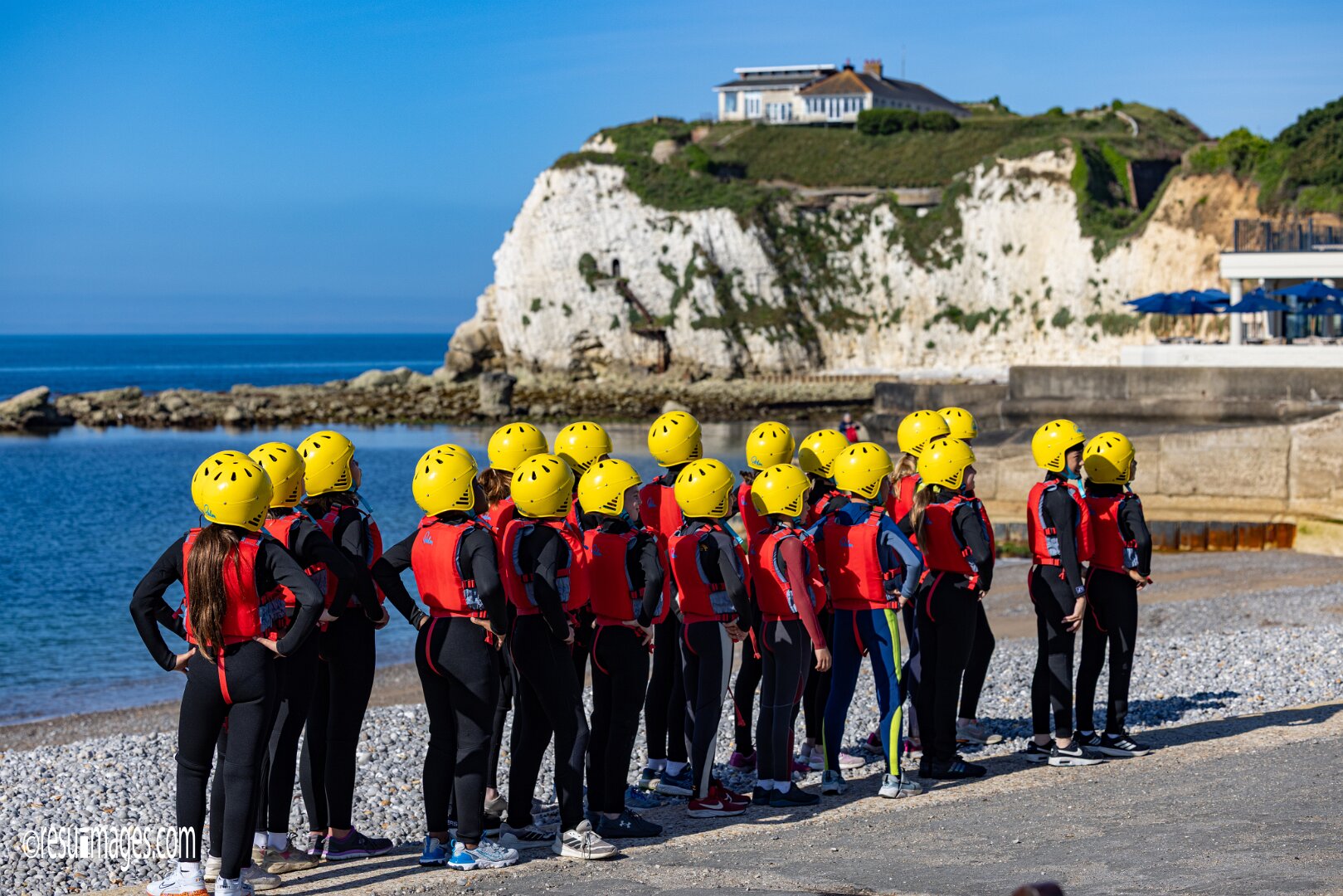
Freshwater Bay, Isle of Wight - United Kingdom

Peter and the Battle of Britain

Freshwater Bay was not only a picturesque place during the Second World War, but also an important military zone. Its proximity to the French coast made the Isle of Wight a frontline area, and Freshwater Bay witnessed dramatic events. A boy named Peter, who lived with his grandparents, spent his days scanning the sky for aeroplanes. In 1941, on the day of the Battle of Britain, he and his friend saw a large number of German bombers on the horizon. A deep roar filled the air and the boys knew they were in danger. They ran for cover, but soon the familiar sound of British Spitfires and Hurricanes could be heard. The British pilots surrounded the enemy aircraft and eventually drove them away over the English Channel. Peter later described the sight as extraordinary and unforgettable. The area around Freshwater was frequently the scene of dogfights. Many aircraft crashed, some of them in the fields near Farringford Farm and on the Tennyson Downs. To prevent enemy aircraft from landing, soldiers had dug long trenches in the Downs. Peter also saw pilots who were able to parachute out of their crashing planes. Sometimes British airmen were shot at by the Germans as they floated to the ground. Freshwater Bay also witnessed tragedy at sea. In April 1943, two Royal Navy landing craft sank here during a severe storm. Many sailors and Royal Marines drowned in the rough seas. The history of Freshwater Bay during the Second World War is not only about military decisions, but also about the experiences of ordinary people who lived through the horrors of war.

Mobirise Website Builder

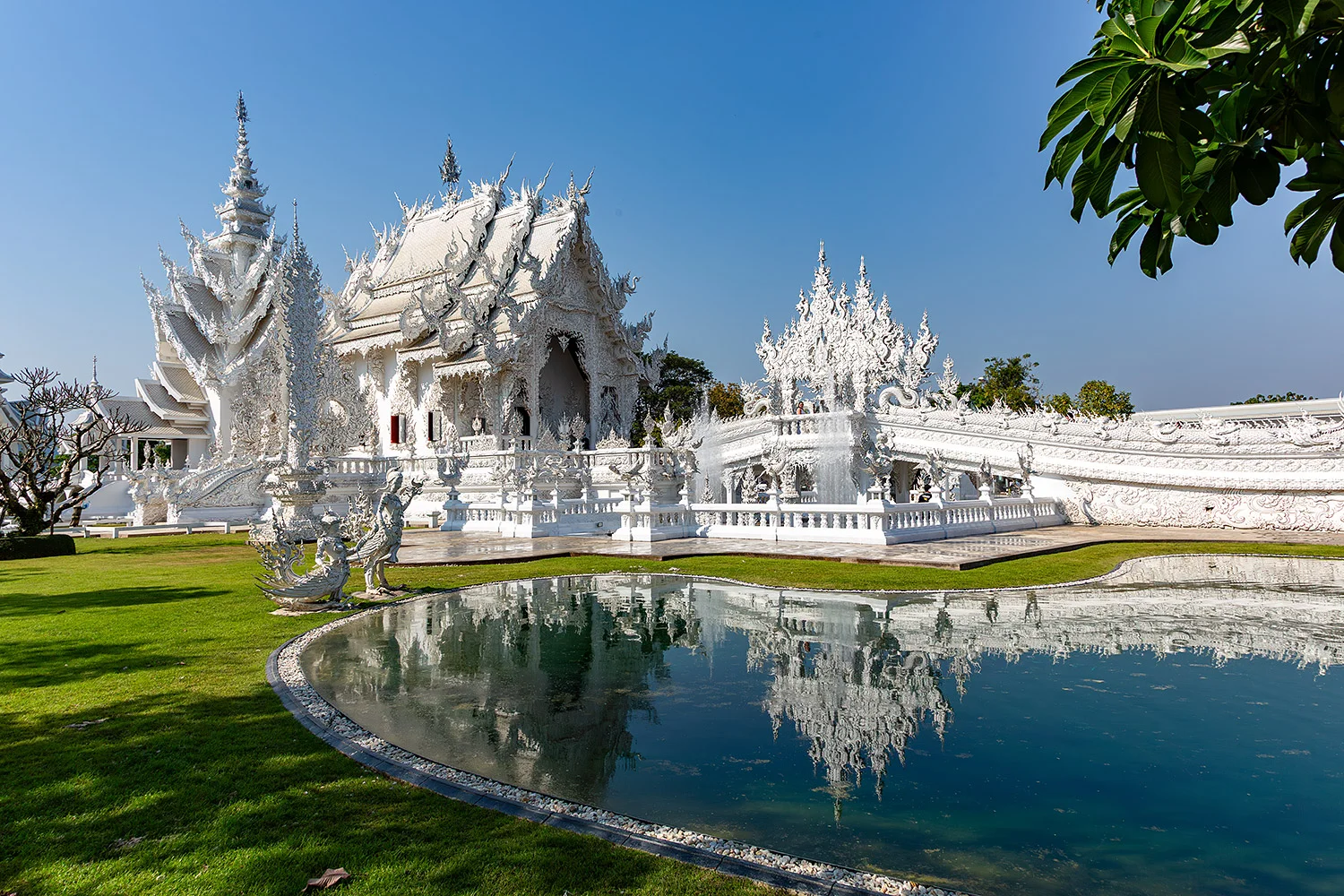
Wat Rong Khun - White Temple - Thailand

Wat Rong Khun - White Temple

Just outside the city of Chiang Rai near Chiang Mai lies the breathtaking white temple Wat Rong Khun. Wat Rong Khun is one of the most modern temples in Thailand. This temple jewel was created by the Thai artist Chalermchai Kositpipat, who financed the construction of the white temple himself and with the help of donations. The artist had deliberately avoided major donors. The history of this work of art began with its construction in 1997 and it is currently one of the most famous sights in northern Thailand.

Mosquee Hassan II

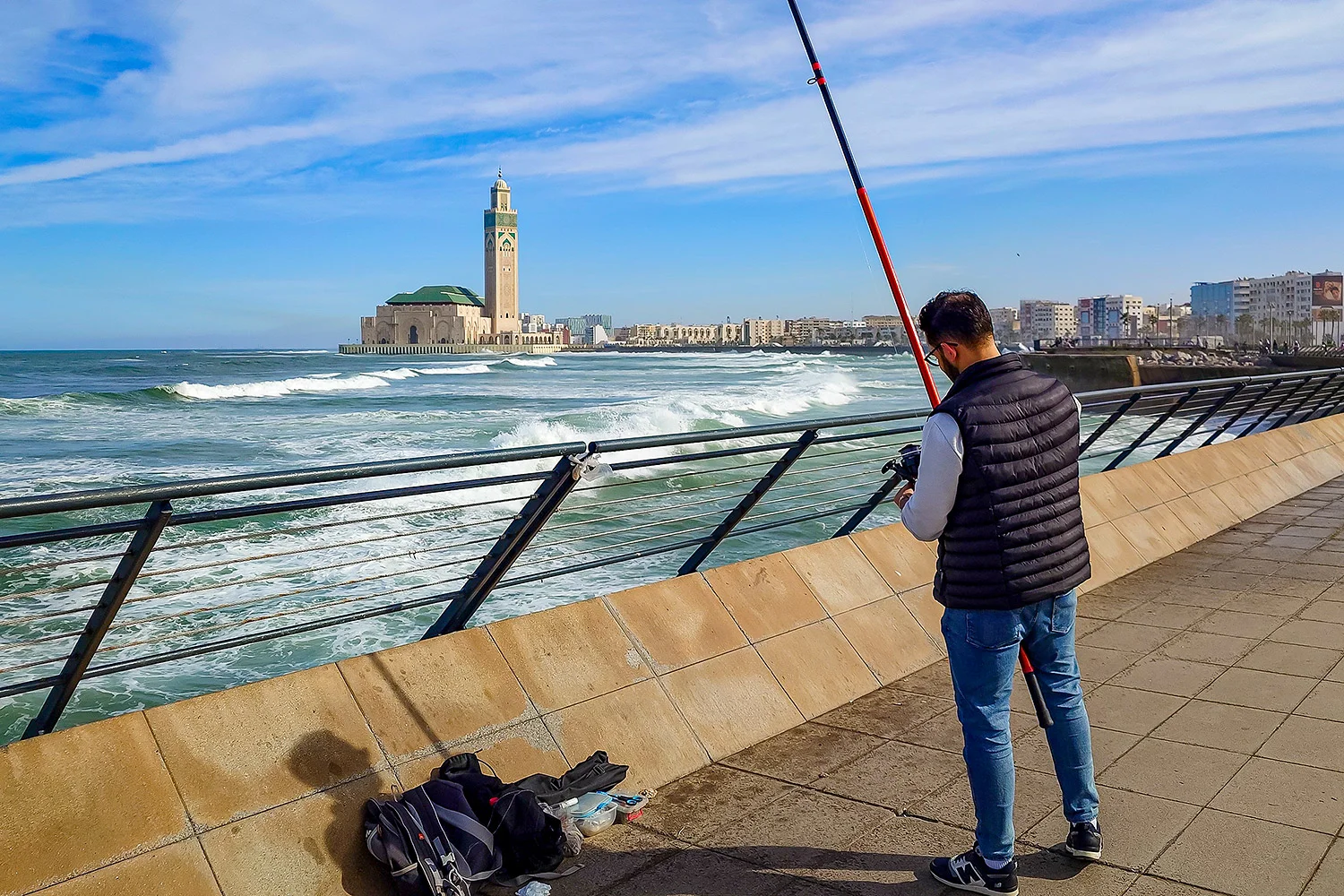
Mosquee Hassan-II, Casablanca - Morocco

Mosquee Hassan-II
Second largest mosque in the world

In the beginning, it was just a vision: a monumental building that would reflect the soul of Morocco. King Hassan II wanted to
give Casablanca such a spiritual and cultural landmark, and in 1980 he declared that he wanted to build a mosque that stood ‘on the water’ because ‘God's throne was above the water’. This marked the beginning of an unprecedented mobilisation of the Moroccan people. Millions of Moroccans – farmers, merchants and ordinary citizens – donated to finance the ambitious project. With these public donations and under the direction of French architect Michel Pinseau, construction of the mosque began in 1986. The construction site, built on a specially designed site on the Atlantic coast, was a masterpiece of engineering and craftsmanship. More than 10,000 craftsmen from all over the country worked tirelessly. They carved cedar wood, moulded stucco and assembled millions of mosaic tiles into intricate patterns that showcased Moroccan craftsmanship. Traditional techniques were combined with state-of-the-art technology: The mosque was built to be earthquake-proof and was given a retractable roof that allows prayers to be performed in the open air. In 1993, after seven years of construction, the mosque was inaugurated. It stood majestically above the sea, its 210-metre-high minaret, once the tallest in the world, towering into the sky. At night, a laser beam shone from its top towards Mecca. For many Moroccans, the building became a powerful symbol of their faith, their craftsmanship and their national pride. It was not only the work of a king, but a true monument to the people.

La Pedrera

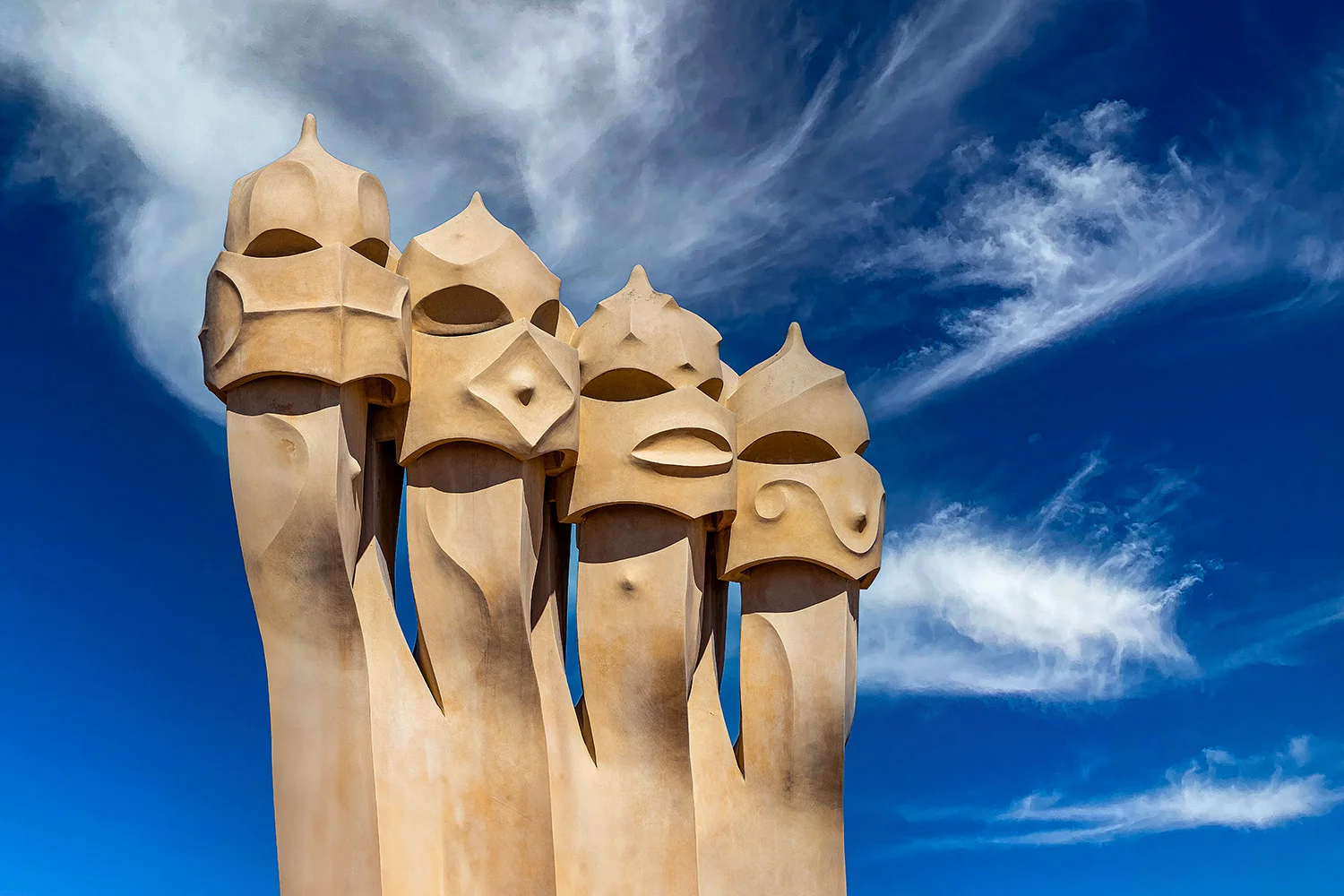
La Pedrera, Barcelona - Spain

The Architectural Genius Antoni Gaudí

The air was warm and thick with the scents of the Mediterranean as the young Antoni Gaudí (1852-1926) wandered through the Catalan countryside as a child. His bones often ached with rheumatism, preventing him from playing with the other children. Instead, he immersed himself in nature, his eternal teacher. He studied how the wind bent the branches of the pine trees, how the sun danced through the foliage, and how the water in the streams splashed over pebbles. He understood that there were no straight lines in nature, only elegant curves and perfect geometries that were in harmony.
Later, as an architect in Barcelona, he remembered these lessons. While his contemporaries adhered to rigid, linear building plans, Gaudí shaped his buildings like living organisms. He used the spiral shape of snail shells, the structure of honeycombs and the arches of tree trunks to create his bold designs. His houses breathed, his chimneys resembled sentinels, his facades shimmered like the scales of a dragon. But while the world admired his masterpieces, Gaudí himself became increasingly modest and reclusive. He devoted his life to building the Sagrada Familia basilica, a monumental work reflecting his deep religious faith. One afternoon, lost in thought on his way to church, he overlooked a tram. In his simple, worn clothes, he was mistaken for a beggar and did not immediately receive the necessary help. Three days later, after his death, thousands of people flocked to his funeral to pay their last respects to a genius. But Gaudí's spirit lived on in his unfinished cathedral. His unshakeable conviction that ‘originality is a return to the source’ continues to inspire architects and artists worldwide, reminding them to seek the truest and most beautiful forms in nature.

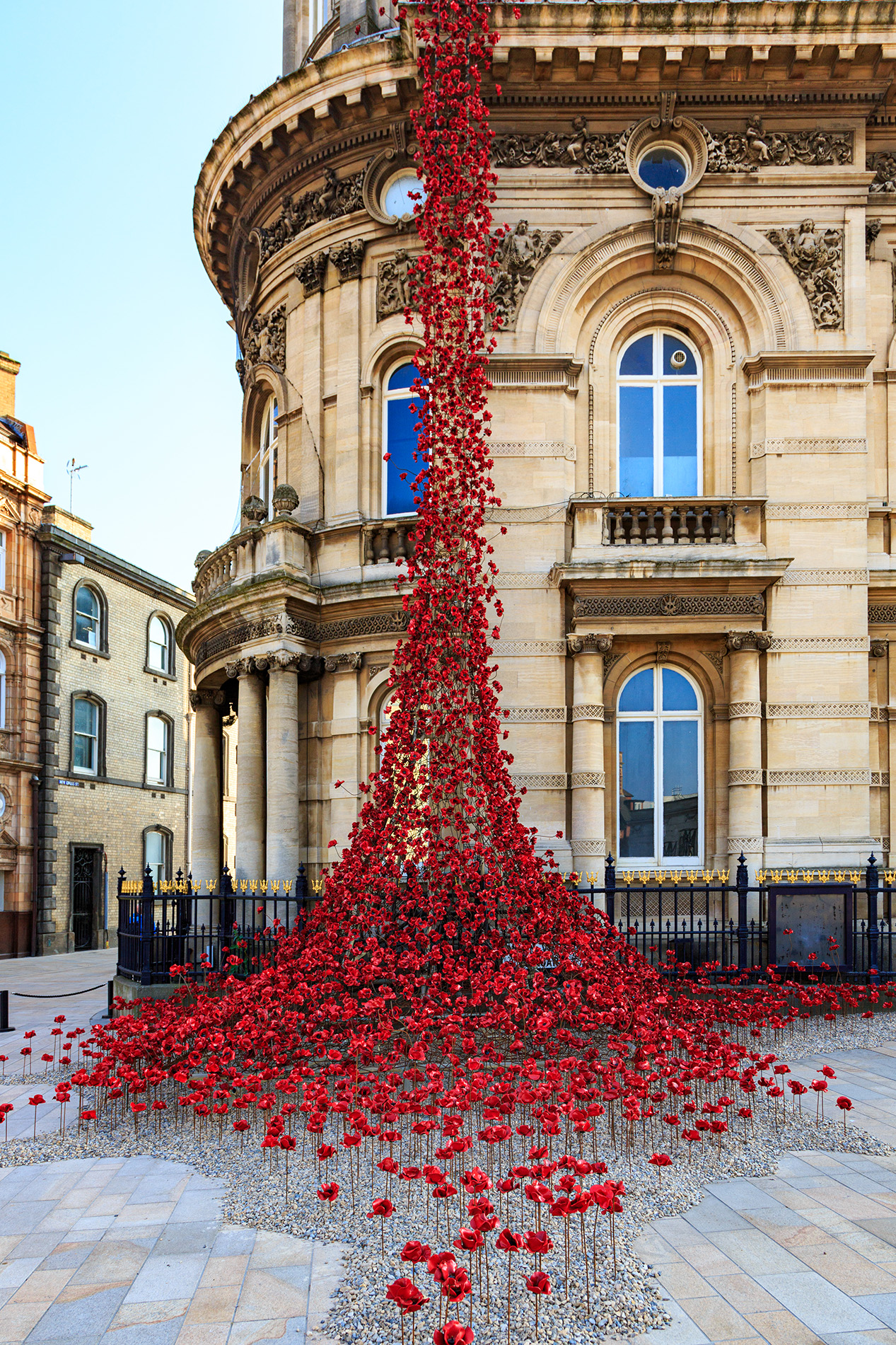
Weeping Window, Hull Maritime Museum

Weeping Window, Hull Maritime Museum - United Kingdom

Weeping Window

A sculpture of thousands of handmade ceramic poppies has been erected in Hull to commemorate the fallen of the First World War. "Weeping Window" was presented in the Maritime Museum as part of the Capital of Culture celebrations. The building in the city centre, the former Dock Offices, tells the story of Hull's seafarers. The location was chosen to highlight the sacrifices made by the Merchant Navy and the Royal Navy. The building in Queen Victoria Square witnessed many of the key events of the First World War in Hull. Weeping Window is part of the poppy installation Blood Swept Lands and Seas of Red, which was created to mark the centenary of the First World War and was originally on display at the Tower of London in 2014. Each poppy in the original exhibition represented a death in the British Armed Forces during the 1914-18 war, totalling 888,246. Artist Paul Cummings and designer Tom Piper created the Weeping Window installation.

Koenigspalast Bangkok

Monks on their way to Wat Phra Kaeo - Thailand

Monks on their way to Wat Phra Kaeo

Bangkok's temples play an important role in the everyday lives of the locals, 95% of whom are Buddhists. They are pilgrimage sites and places of peace and meditation. By far the most famous temples in Bangkok are located on the banks of the Chao Phraya and are called Wat Phra Kaeo, Wat Pho and Wat Arun. The temple Wat Phra Kaeo is located on the grounds of the Royal Palace in Bangkok. The colourful temple is one of Bangkok's greatest sights, a place of pilgrimage for Buddhists and a must-see for every visitor to Bangkok.
Phra Phutthayotfa Chulalok (Rama I) had the Grand Palace and Wat Phra Kaeo built in 1782, immediately after his coronation as king. The palace was the official residence of the kings of Thailand, the former Kingdom of Siam, for 150 years. Today, it enchants visitors from all over the world with its pomp and splendour: golden chedis, glittering and mystical-looking statues, richly decorated buildings and beautiful murals depicting scenes from the life of Buddha. The Chakri Maha Prasat, completed in 1882, is located in the centre of the palace grounds surrounded by high walls. 

The Killing Fields

The Killing Fields - Cambodia

The Killing Fields

The Khmer Rouge military leader Pol Pot was responsible for the murder of 21% of the Cambodian population. The genocide in Cambodia was the result of a Khmer Rouge socio-political project based on Mao's communism to create a classless agrarian society. The Khmer Rouge ruled Cambodia from 17 April 1975 to 7 January 1979, murdering between 1.6 and 3 million people (21% of the approximately 7.8 million population) during this period. Cambodian civilians died from starvation, torture, executions, medical experiments, untreated diseases, forced marches, forced labour and other forms of violence. The Khmer Rouge ruled a totalitarian state in which citizens had virtually no rights. They abolished civil and political rights, private property, money, religious practices, minority languages and foreign clothing. The government built huge prisons where people were imprisoned, tortured and executed. The most notorious of these prisons was S-21 in the capital Phnom Penh, where traitors and their families were kidnapped, photographed, tortured and killed. Of the approximately 17,000 men, women and children taken to S-21, only about a dozen survived. There were mass graves all over the country, which became known as Killing Fields. In November 1978, when Vietnam invaded and put an end to Khmer Rouge excesses, millions of Cambodians died at the hands of the Khmer Rouge.

Lothar memorial on the Siedigkopf

Lothar Memorial - Germany

Lothar Memorial

On Boxing Day 1999, storm Lothar swept across the Black Forest, leaving a wide swathe of devastation in its wake and causing damage totalling more than 11 billion euros. The peak wind speeds reached an incredible 272 kilometres per hour. The hurricane snapped century-old trees like matchsticks. Years after Lothar, the trail of devastation is still clearly visible in the forests. In Baden-Württemberg alone, 25 million cubic metres of wood were flattened. More than 60,000 hectares were clear-cut. The effects of Lothar were serious. The Lothar memorial near the Moosturm tower commemorates the hurricane in 1999 and was created by Gengenbach artist Norbert Feger.
The memorial is a very popular excursion point with a view over the Black Forest and the Rhine plain.

Cassava

Cassava - Laos

Cassava

Little known in Europe, cassava (other names include manioc, yuca, etc.) is a useful plant from the spurge family. Cassava has its origins in Brazil. It was spread by Portuguese slave traders in the 16th century and is now primarily found in tropical regions. The perennial shrub grows up to three metres high. It has long-stemmed, palmate leaves that resemble the foliage of hemp. The most interesting thing about cassava is its large taproots. The roots are on average 30 to 50 centimetres long. Their diameter is five to ten centimetres. The cassava tuber is brown on the outside and white to slightly reddish in colour on the inside. Cassava is an important staple food for people around the world. Its starchy tuber is a healthy and nutritious food whose importance is increasing in times of climate change, as the edible plant can withstand both heat and drought. Cassava is the eighth most important food crop in the world (2022) and is the main food source for more than 500 million people.

Durdle Door Arch

Durdle Door Arch - United Kingdom

Durdle Door Arch

The name "Durdle" comes from the Anglo Saxon "thirl", meaning a pierced hole or opening. There are five types of rocks found in these cliffs. Each of them was formed under water and later tilted by the collision of continents. The hard Portland rock was breached by the sea, creating Durdle Door and the stacks that describe the coastline of 10,000 years ago. The softer rocks behind were washed away leaving an eroding line of chalk cliffs. Several holes can be seen in the rock above the arch, representing the fossilised remains of the cycad trees that grew here 147 million years ago.

The old tree won't give up

The Old Tree won't give up - Germany

The Old Tree won't give up

At Gengenbach, near the town of Eisingen, an old tree continues to fight for its survival. Wild thorn bushes, rose hips and other parasitic climbing plants entwine an almost crushed, dead tree. A branch stretches upwards like an arm, as if the tree is saying, "You haven't defeated me yet."
Despite its overgrowth and apparent decline, the old tree shows signs of life. Small green shoots sprout from its bark, a silent testimony to its perseverance and strength. The villagers, who have known the tree for generations, regard it with reverence and a touch of mysticism. They tell stories of its past, how it once provided shelter from storms and served as a meeting place for couples in love.
One day, a young artist from the town decides to immortalise the tree in a painting. He sits down next to the tree with his easel and begins to transfer its shapes and colours onto the canvas. As he paints, he feels a deep connection to the tree, as if it were whispering its life story to him.
The painting is finished, and it shows not only the raw beauty of the tree, but also its unwavering willpower. People come from far and wide to see the work of art and hear the legend of the old tree. And so the tree lives on, not only in the physical world, but also in the hearts and memories of the people who honour its memory.

Gilded temple figures in the Buddhist temple Prey Nob

Gilded Temple Figures - Cambodia

Gilded Temple Figures in the Buddhist Temple Prey Nob

Even during Buddha's lifetime, the first images and statues depicted his life. For example, following the earnest request of a Sinhalese princess, Buddha sent her his own image painted on cloth. When Buddha travelled to the distant Trayatrimsha Heaven of the 33 Gods to give liberating teachings to his mother who had been reborn there, King Udayana of the then kingdom of Kaushambi made a replica of Buddha out of sandalwood to pay his respects. After the Buddha returned to the monastery, he said to the statue that had approached him to greet him, "Return to your seat. After I have entered Parinirvana, you will serve as a pattern for the four classes of my disciples." Thereupon the statue returned to its seat. This was the first of all Buddha images to be copied in the time that followed. According to this story, Buddha only did not allow the statue to be worshipped during his lifetime at that time, but already gave instructions that it should serve as a pattern for all further Buddha images after his death. On another occasion, Buddha allowed King Bimbisara to have an image made of him. This image was inserted into the so-called Wheel of Life, which expresses the central teachings of Buddha, and given as an extraordinary gift to a neighbouring king. Buddha explicitly confirmed the very beneficial effect of this image.

Picturesque Bruges

Picturesque Bruges - Belgium

Picturesque Bruges

The Flemish, picturesque city of Bruges is world-famous for its medieval architecture. Bruges has a rich history and unique atmosphere. The old town was declared a UNESCO World Heritage Site in 2000. Around 120,000 people live in Bruges. Almost 30 times as many tourists visit the historic centre every year. The name Bruges is also a reference to the city's bridges. Bruges is often called the Venice of the North because of its many canals and bridges. The canals have been the connecting arteries of the city for centuries.

Floating orange tree in the old city of Jaffa

Floating Orange Tree in the Old City of Jaffa - Israel

Floating Orange Tree

A fully grown orange tree hangs from chains; literally floating about a metre above the street. In 1993, Israeli artist Ran Morin installed the tree in the old streets of Jaffa. The tree is fed by a drip system and continues to bear fruit. Jaffa oranges were once Israel's most famous export product. As early as the mid-19th century, they were grown by the Arab Hajaj family in groves around the city of Jaffa and exported in large quantities to Europe via the nearby port, alongside soap, barley, sugar and cotton. The Jaffa orange is a cross between the bitter Baladi orange and Chinese sweet oranges. The brand "Jaffa orange" was invented by German Pietists, Templars from Württemberg. After the founding of the State of Israel 70 years ago, the Jaffa orange increasingly lost its importance. The fact that Israel's agriculture has long specialised in more lucrative products thanks to high-tech probably began with the invention of drip irrigation in the Hazerim kibbutz.

Gigantic Sculptures near the Georgian Army Road

Gigantic Sculptures near the Georgian Army Road - Georgia

Gigantic Sculptures in Georgia

The huge boulders at the foot of the mountain, near the village of Sno, some of which are several metres high, are sculptures by well-known Georgians. The stone sculptures, which look like scattered boulders on the mountain slopes, were made by the Georgian sculptor Merab Piranishvili. The sculptor has depicted with the stone sculptures, the "faces of the true patriots who saved Georgia". "When you stand between them, it seems as if you hear them talking, and then you think they are talking to each other," says the sculptor. Various people help him get the heavy stone blocks out of the Dariali Gorge, on the border with Russia, and bring them to their destination. Piranishvili thinks that artistically he should never do what others have already done. His purpose in life is to search for something new.

Buddha on the way to Nirvana

Buddha on the Way to Nirvana - Laos

Buddha on the Way to Nirvana

In Wat That Luang Tai, the reclining, golden Buddha is depicted in the parinibbana asana position. This means that Buddha is at the transition into Nirvana. The reclining Buddha is located just a few steps from the Lao national symbol and most important religious monument, the great stupa Pha That Luang, in Vientiane. Legend has it that Buddha himself visited this site in his time and predicted the construction of a reliquary. According to tradition, the Indian king Ashoka had a stele erected at this site as early as 300 years before Christ, under which Buddha's hair or bones are said to lie. Other legends tell of a sanctuary of the Mon or of the residence of two serpent beings of the Naga, who are said to have been located here. In any case, it is certain that King Setthathirath had the That built when he moved his capital from the royal city of Luang Prabang to Vientiane. In 1566, the Pha That Luang stupa was consecrated by the king.

Mousehole, the most beautiful village in England

Mousehole - England

The Most Beautiful Village in England

Mousehole is a small fishing village in Cornwall, situated just over three miles south of Penzance. It was once a busy port, famous for landing huge catches of pilchards. The village retains much of its historic character and is now popular with visitors in the summer. Guidebooks and Dylan Thomas (Welsh poet and writer) refer to the British harbour village as the most beautiful village in England. Mousehole is associated with many names. Some say that Mousehole takes its name from the large cave at its western end, which for years was a hideout for smugglers. Others say the name is derived from the Cornish word Moeshayle, meaning "at the mouth of the River of Young Women". Still others claim that Mousehole used to be called Porth Enys or "Port of the Island". Whatever the case, the town developed around its harbour and its floating fleet. Records dating back to 1266 describe it as an important fishing port. The Keigwin Arms inn is remembered for Dorothy (Dolly) Pentreath. She was the woman considered to be the last fluent speaker of the Cornish language. At the inn she enjoyed her pint and smoked her pipe. She was a colourful character and legendary for swearing in a violent torrent of Cornish words when she got angry. Dolly died in 1777 at the age of 87. She is buried in the church where a monument marks her final resting place.

The Colosseum in the heart of Rome

The Colosseum in the Heart of Rome - Italy

The Colosseum in the Heart of Rome

The Colosseum of Rome, which remains only in ruins, still represents the largest amphitheatre ever built in history, with an elliptical structure 188 metres long, 156 metres wide and 57 metres high. Built of brick and faced with travertine stone, it was divided into five levels and could seat more than 50,000 people. The areas were divided according to social classes. The closer one sat to the arena, the higher the rank to which one belonged. Construction of the amphitheatre began around 70 AD under Emperor Vespasian. It was financed, among other things, by the gold treasure looted from the Temple of Jerusalem in 70 AD. The Colosseum was built in a valley. An existing lake belonging to Nero's Domus Aurea between the Palatine, Esquiline and Caelius hills was drained for this purpose. Emperor Titus inaugurated the Colosseum in 80, but 2 years later the work was only completed with the construction of the upper floors.

The Charles Bridge in Prague

The Charles Bridge in Prague - Czech Republic

The Charles Bridge in Prague

The 500-metre-long Charles Bridge in Prague connects the Malá Strana and Staré Mesto districts; the Old Town and the Lesser Town over 16 arches. The Holy Roman Emperor, Charles IV, who was born in Prague on 14 May 1316, commissioned the construction of the bridge in 1357. The Charles Bridge over the Vltava is one of the oldest and longest Gothic stone bridges in Europe. Bounded by two towers, it is open only to pedestrians and is very busy almost around the clock. A must for every visitor to Prague, if only because the view over the river and of the castle from here is simply great. The bridge has connected Prague's Old Town with the Lesser Town for 650 years. An average of 30,000 pedestrians stroll across the bridge every day. Numerous statues of saints line both sides of the bridge, such as St. Christopher, St. Joseph or St. John the Baptist. The most famous saintly figure, however, is that of St. Jan Nepomuk, who was thrown into the Vltava River at this spot, as the story goes. The bridge is something of an open-air museum, even though numerous figures can no longer be seen as originals.

View from the Feldberg in Winter

View from the Feldberg in Winter - Germany

View from the Feldberg in Winter

In winter, the Feldberg (1,493 m) is known as an excellent winter sports area. The Feldberg is the highest mountain in the Black Forest and the centre of the winter sports region Hochschwarzwald. The altitude of 950 - 1,450 metres and the snow on approx. 5 km of piste bring a wonderful winter feeling. Skiing is usually possible on more than 100 days. But snow enthusiasts will also find wonderful conditions for cross-country skiing (700 km of cross-country trails stretch across the Upper Black Forest), winter hiking, tobogganing, snow kiting and snowboarding. The amount of snowfall has probably changed in recent years due to the climatic conditions. Compared to the 1960s, the amount of snowfall on the Feldberg has dropped significantly from more than 6.06 metres per winter to 2.92 metres in recent years. A decrease of more than half. In the same period, the number of days the Feldberg was covered in snow fell from 189 to 161. Regardless of this, the Feldberg holds the snow record in the Black Forest. Despite less snow overall, the ski season in the winter sports centres of the Black Forest has not diminished. On the contrary. This is mainly due to the support of modern snow-making facilities.

Pomegranate is said to be a super fruit

Pomegranate is said to be a Super Fruit - Thailand

Pomegranate is said to be a Super Fruit

Pomegranate seeds taste juicy, crunchy and sweet and sour. Many people see the pomegranate as a super fruit. The pomegranate (Punica granatum) belongs to the loosestrife family. The word "pomegranate" is derived from the Latin granum, which translated means seed or grain and goes back to the countless seeds in the pomegranate. The pomegranate is said to have numerous positive effects on health. It is said to have an anti-inflammatory effect and a positive effect on cardiovascular diseases, to protect blood vessels and to help with menopausal symptoms. However, this has not been scientifically proven. Nevertheless: Pomegranates contain numerous vitamins and minerals as well as secondary plant compounds, especially polyphenols, which are said to have an antioxidant effect. Pomegranate seeds and pomegranate juice are therefore particularly popular. The ingredients of the pomegranate include the minerals potassium, calcium, iron and phosphorus as well as vitamins C and B and folic acid. Compared to the amount in oranges (about 70 milligrams), the pomegranate offers about 7 milligrams less vitamin C per 100 grams. Another thing to mention is the high content of so-called polyphenols. Polyphenols belong to the secondary plant pigments. Particularly intensely coloured fruits such as blueberries or the pomegranate indicate a higher content of these special substances, which have an antioxidant effect. Other antioxidant components are ellagic acid and punicalagin/punicalagenes.

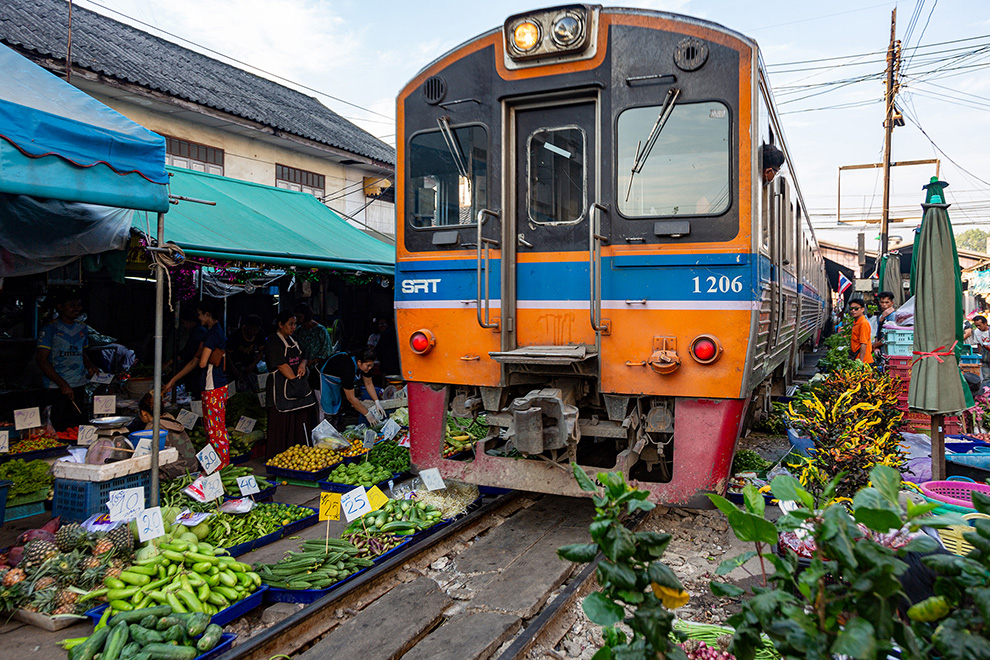
Mahachai Market

Mahachai Market by the Railway - Thailand

Mahachai Market by the Railway

The train passes through the middle of the vegetable market in Mahachai. One gets the impression that the train will carry the vegetables on display. That's how close the tracks are to the stalls. The Mae Klong Market has been held at this exact spot for over 100 years, even before a railway line was laid through here. When the time came, the Thai traders were faced with the decision to move or stay? The traders decided to stay, and reached a rather unofficial agreement with the railway company. They "share" the tracks. It is rumoured that one reason for the traders to continue selling along the tracks is that they do not have to pay stall fees here. The Thais love their Railway Market and by now the probably most dangerous market in the world is also popular among tourists. The market itself is everywhere. Between narrow walls of houses, the railway tracks wind through the middle of the bustle. Stalls pile up guavas, lychees, juicy mangoes and fresh prawns under sun-protecting awnings. Even space for tiny cookshops can be found at every corner. You might think it's a "normal" Thai market until you hear the whistle of the approaching train. Then a hustle and bustle takes over the traders and within a few seconds everything is cleared away where fresh goods were just offered. The awnings are folded up and then the train arrives. With a height of almost four metres, it is a little frightening when it passes by just a few centimetres away. The train moves through the market at walking pace.

Cliffs of Moher

Cliffs of Moher, County Clare - Ireland

Cliffs of Moher, County Clare

The Cliffs of Moher are one of Ireland's most famous sights. The Cliffs, not far from Knockevin in County Clare, are completely vertical and the cliff edge is abrupt. On a clear day the view is stunning, with the Aran Islands engraved in the waters of Galway Bay. From the cliff edge you can hear the roar far below as the waves crash and gnaw at the soft shale and sandstone. Legend has it that the cliffs are home to otherworldly beings and mystical creatures. A witch named Mal is said to have fallen in love with Cú Chulainn, the brave warrior of the Knights of the Red Branch. Cú Chulainn, however, did not return her feelings. Undeterred, Mal pursued him relentlessly throughout Ireland. Eventually, the chase led them to the southern region of the Cliffs of Moher, near the mouth of the Shannon River, where Cú Chulainn jumped onto an island known as Diarmuid and Grainne's Rock. In another legend of the Mermaid of Moher, a local fisherman came across the presence of a mermaid while casting his line near the Cliffs of Moher. Intrigued, he struck up a conversation with the mystical creature. While they were talking, the fisherman noticed a magical cloak resting near a rock. This cloak was essential for the mermaid's return to the sea, as she had to wear it. However, his desire for her magic cloak quickly consumed him. The man seized the opportunity, snatched the cloak and fled hastily to his house, carefully hiding the precious object. - The cliffs are full of stories about ancient warriors, witches and giants.

Adventure Park, Pilatus Rope Park

Pilatus Rope Park - Switzerland

Adventure Park, Pilatus Rope Park

A man balances on a rope at a dizzy height. The mountains of central Switzerland can be seen in the background. At an altitude of more than 2,000 metres, you can experience various adventures in the Pilatus Rope Park.
The Pilatus Rope Park is the largest adventure park in Central Switzerland. 

Traffic jam at Cap Formentor, Majorca

Traffic Jam at Cap Formentor - Spain

Winds Meet At Cap Formentor

Where the rugged Tramuntana mountains plunge into the deep blue of the Mediterranean, you will find Cap Formentor. Often called the meeting point of the winds, this dramatic peninsula offers some of the most breathtaking and untamed vistas in the Balearics. The winding roads, sheer cliffs, and the iconic lighthouse standing defiant at the edge of the world make it a place of raw, unyielding beauty. These images capture the wild spirit of an island far beyond its quiet beaches.

Hovercraft

Hovercraft - England

Hovercraft

The hovercraft is a unique vehicle that can be used to travel over water, flat land and marshland, hovering above the ground on an air cushion. The official term for travelling on a hovercraft over water is "flying" and not "sailing". The hovercraft was invented in 1955 by Sir Christopher Cockerell. In 1956, he was granted a patent for the boat, which he called the hovercraft. The Saunders-Roe company built the first SR-N1 hovercraft in 1959 in East Cowes, Isle of Wight. In the same year, the hovercraft crossed the English Channel from Dover (England) to Calais (France). This great tradition has been continued for many years by Hovertravel, the oldest hovercraft operator in the world, which celebrated its 50th anniversary as operator of the Isle of Wight Hovercraft Service in 2015.
Over the years, the hovercraft has been built by changing companies with varying degrees of commercial success, such as Saunders-Roe, The British Hovercraft Corporation, Westland Aircraft, Griffon Hoverwork's, ... 

Gadi Sagar Temple, Rajasthan

Gadi Sagar Temple - India

Gadi Sagar Temple, Rajasthan

The two temples stand in the water of Gadisar Lake in Jaisalmer, Rajasthan. Depending on the water level, the visible temple stairs can be accessed dry-footed from the mainland. The pigeons love the roofs of the temples. They appear on the roofs as an integral part of the buildings. Gadi Sagar Lake, one of the most famous tourist attractions in Jaisalmer, was originally a man-made reservoir that served as a source of water for the people of Jaisalmer. The reservoir was created in 1367 by the city's first ruler, Maharawal Jaisal, and remodelled by Maharawal Garsi Singh. The banks of the lake consist of shrines, temples, ghats and chattris. The lake to the south of the city has an entrance arch of yellow sandstone, Telia-Pol, created by Telia, a royal courtesan. One can take a boat ride here or simply go for a walk. The Jaisalmer fort in the background is a magnificent sight. This lake is mostly visited during the annual celebrations of the Gangaur festival.

The Bell Tower

The Bell Tower - Georgia

The Bell Tower in Tbilisi

One of the main attractions in Tbilisi, Georgia, is a huge leaning bell tower built in 2010 by Rezo Gabriadze. There you can see the biggest and the smallest clock in the city. At the end of every hour, an angel comes out of the beautifully painted door and rings the bells with a small hammer. A larger door opens only twice a day, at 12:00 and 19:00. Tourists can see an entertaining show when the second door opens. It is a mini puppet theatre and shows "The Cycle of Life".
In the Old Town, on Shavtelidze Street, next to the bell tower is Rezo Gabriadze's theatre. Rezo Gabriadze is a painter, theatre director, writer and also a sculptor. In 1981, he founded the Puppet Theatre in Tbilisi, which conquered the hearts of the audience from the first performances and now travels around the world. 

Hadrians Wall

Hadrian’s Wall - United Kingdom

Hadrian’s Wall

The most important structure from Roman times in Great Britain is without doubt Hadrian's Wall. Despite the many centuries that the wall has existed, it is one of the best-preserved Roman border fortifications. It was built in the years 122-130 AD by Emperor Hadrian, who not only gave it its name, but also fulfilled an important task for what is now the English part of the island by building the rampart. It served as the northern defence line of the then Roman Empire against the Celtic Picts. Emperor Hadrian was of the opinion that if the Scots could not be conquered, they should at least be kept at bay. Because these "savages" in the north were difficult to bring under control. The region could not be occupied. The harsh climate and the lack of supply routes thwarted the proud Romans. And so the cheaper option was chosen. The rampart was built, sealing off the northern part of the island. Hadrian's Wall is around 120 kilometres long. It runs from east to west between Walls-end-on-Tyne and Bowness-on-Solway. While the eastern part of the wall was built of stone, it was decided to use peat for the western part. These different building materials resulted in different heights of Hadrian's Wall. Hadrian's Wall still exists in large parts and has been a UNESCO World Heritage Site since 1987. Hikers can discover the entire wall on the Hadrian's Wall Path National Trail. 

Glass Art

Glass Art at Indigo Warsaw - Poland

Glass Art at Indigo

Hotel Indigo Warsaw is located in a historic residential building at the entrance to the fashionable Nowy Świat street. Surrounded by theatres, museums, unusual stories, trendy restaurants and chilled out places, the hotel is perfectly connected to every part of the city. Hotel Indigo offers old and new in the heart of Warsaw's trendy Nowy Swiat district. The boutique hotel combines chic, modern design with historic architecture. The hotel is just a few steps away from Nowy Swiat Street and a short walk from the charming Old Town. You can discover fascinating art across the street at the National Museum and stroll to performances at the towering Palace of Culture and Science. The hotel itself is decorated with taste, style and atmosphere. A fascinating art object made of coloured and differently sized glass spheres floats from the high ceiling in the reception area.

© Copyright 2026 resuimages Photography - All Rights Reserved

Best AI Website Creator